By Mira Fox (TheForward) –
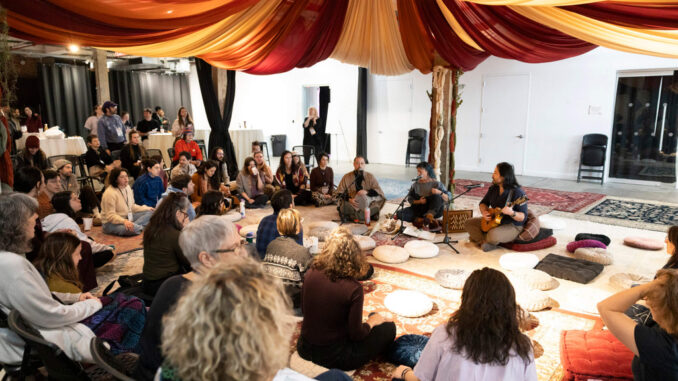
In a townhouse in Greenpoint, Brooklyn, a gathering for Tu B’Av was underway. There was chanting and breathwork, singing and ceremony. Several Brooklyn-based Jewish communities, including Temple of the Stranger and Lab/Shul, had come together for the experience.
These vibes are usually associated with Eastern traditions, paganism or indigenous American practices; most Westerners who want that form of spirituality go looking for it at Buddhist meditation centers or ayahuasca retreats, forms of engagement more often associated with the 1960s or ’70s counterculture movement than with a synagogue.
But a group of rabbis, leaders and spiritual seekers believe drum circles, chanting, meditation and mysticism are, in fact, just as core to Judaism as any rabbinic text — a sort of lost magic that has impeded vibrant, direct spiritual experience.
“I get this sense that my family believed God is dead, God died 2000 years ago when the Temple burned. Everything could only be archaeology,” said Rav Jericho Vincent, who grew up Haredi and now leads Temple of the Stranger, a Brooklyn based Ivri community. “I don’t accept God’s death.”
Instead, Vincent wants to teach a Judaism that is more alive, and more connected to the divine — one that can offer wisdom to Jews and non-Jews alike. To that end, at the Tu B’Av event, Becca Goldstein, a 34-year-old cultural entrepreneur and spiritual practitioner who is helping to build the new movement, announced a new name for what they were doing to those gathered for the ceremony: Ivri.
For some of the attendees, this was a word they’d already been using to describe their spiritual identity, and the announcement was met with celebrations. For others, it was confusing. Ivri is one the oldest words in the Torah for the ancestors of the Jewish people; it’s the Hebrew word for Hebrew. Weren’t they already Ivri?
Defining the term is complicated, not least because the burgeoning movement is more of a loose web of teachers and spiritual seekers than a clearly defined organization with official values or tenets; every single person I spoke to for this story used the word “mycelial” to describe it. (A mycelium is the underground network of thread-like connections between mushrooms.)
“There’s been something happening, certainly in American Judaism for a while now,” said Vincent, who has a book on Ivri Judaism coming out next year. “This mycelial network of a different way of doing and being Jewish that’s embodied and mystical.”
Because of this diffuse nature, it can be hard to pinpoint exactly what Ivri is; there are commonalities — a desire to cultivate a more spiritual and mystical Judaism, an emphasis on the feminine aspect of the divine, a tendency toward participatory rituals, and a strong sense that they are reaching back to ancient or lost Jewish practices. But there’s no central structure meting out decisions or defined set of tenets, and each group operates independently.
There is Vincent, and their Brooklyn-based community, Temple of the Stranger, and Amichai Lau-Lavie and Shira Kline of fellow Brooklyn-based Lab/Shul; their organizations lean into queerness and often incorporate theater into their services. There is Rabbi Zvika Krieger in Berkeley, the spiritual leader of the congregation Chochmat HaLev in Berkeley, and Adena Phillips, founder of a group called Kimu that serves “Jewish spiritual seekers” — both also lead Shabbat at the Burning Man festival as part of a camp called “Milk and Honey.” There is Rabbi Jill Hammer, who co-founded the Kohenet Institute, which ordained Jewish priestesses from 2005 until it closed in 2023 due to leadership changes and the pandemic; she now is the director of learning and practice at Beit Kohenet, an organization offering classes and retreats on Jewish witchcraft, mysticism and sacred practice, all with a focus on the divine feminine. There is Shefa, an organization that cultivates psychedelic use and exploration for Jews.
But whatever the throughline is, it’s magnetic, powerful and popular.
Chochmat HaLev’s membership has tripled in the past three years, regularly maxing out their sanctuary’s 300 person capacity on Friday nights. Their yearlong intensive Jewish learning course, “Go Deeper,” planned for 30 participants, had to cap its first cohort at 90.
The Big Jewish Gathering, a sort of coming-out event for the Ivri movement in Brooklyn, organized by Goldstein, sold out with a waiting list of well over 100 people. The Burning Man Shabbat draws at least a thousand festivalgoers each year to pray in the dust. Vincent has nearly 20,000 followers on Instagram.
Yet Ivri offerings are also controversial. The rituals are so unrecognizable to what people expect Judaism to be that several people I spoke to wondered whether the Ivri movement was really Jewish at all — or whether they wanted to be.
“It’s a totally post-halachic model,” said Shaul Magid, professor of modern Jewish studies at the Harvard Divinity School. (He attended, spoke at and wrote about the Big Jewish Gathering.) “If you write something about this, people will be scratching their heads like, ‘This is crazy.’”
Roots and branches

At the Big Jewish Gathering in January, dozens of Jewish thought leaders and groups came together for a weekend event in Brooklyn. Though the event didn’t advertise the term Ivri, in practice, it was a kind of coming out party for the movement.
The event had some more familiar forms of engagement, such as panel discussions. But there was also drumming and breathwork. Hammer led “Heelooleem,” a vineyard ritual based on biblical descriptions of ancient Jewish celebrations; participants sang and danced as they stomped grapes in a wooden basin.
These rituals may sound New Age-y, but Ivri practitioners argue they are in fact callbacks to Jewish practice that was lost.
“We can read about the libations in the temple. They’re like, ‘OK, why don’t we just do them — if they’re so powerful and so important, then why don’t we just do them?’” said Magid by way of example.
It’s clear that Jewish practice has changed over time. Women’s rituals and folk rituals were rarely recorded, meaning they were lost over the years. Centuries of persecution forced Jews to gather more quietly. And, after the Temple’s destruction, rabbis had to form a new tradition that could survive without being anchored to a particular land; in creating a new, portable religion, they shaped Jews into the people of the book.
Those in the Ivri movement feel that something important was lost in that process, including the wisdom of women, an ecstatic joy in prayer and Judaism’s connection to the earth. And, to critics who believe they are departing too far from tradition, they say that Judaism has always changed; they’re simply participating in that custom.
“When I hear those kinds of questions, I imagine them being asked of the rabbis who were forming what became rabbinic Judaism. How can you not have animal slaughter? How can you not have priests?” said Vincent. “I imagine the rabbis must have gotten that pushback, because they remade Judaism more than anything.”
The Ivri movement doesn’t want to get rid of existing wisdom — “I’m always trying to balance like, give me that quote from Rabbi Akiva, and also give me the wisdom of the mothers and aunties,” said Vincent. But they do want to add to it.
That said, many of the teachers I spoke to voiced a deep suspicion of preserving what was done purely for the sake of preservation, a tendency toward nostalgia-driven practice that they believe has reified.
“Too many people say, ‘I come to prayer services not because the prayer services are meaningful in any way but because it reminds me of the prayer services of my youth — even though I was bored out of my mind as a kid, and remain bored out of my mind,’” Krieger said. “I’m saying no, spiritual practice should be meaningful! It’s not just preserving tradition for the sake of preserving tradition.”
Hammer voiced a similar stance. “Ultimately rituals survived to support people. They exist to help people live in meaningful ways. And what can happen if you hold the rituals too tightly is that they become a kind of museum, like we’re going to do this thing to remember what our ancestors did,” she said. “And we forget what that was meant to do. We forget that the ritual was meant to transform.”
Making the old new again
Some of the boldness these leaders feel in designing rituals that are so different from what most Jews might expect may spring from the fact that many of them grew up more religious than the average American Jew. Krieger grew up Orthodox, as did Adena Phillips, who leads the Burning Man Shabbat with him. Goldstein went to a Conservative day school and an Orthodox synagogue. Vincent grew up Haredi.
Each felt unsatisfied with the Judaism they were raised with — restrictions around gender norms and limitations, a culture of social conservatism. And they felt the Judaism they were given was too cerebral, focused on studying texts instead of practicing them.
As Goldstein put it, “My experience is that it’s very hard to have a direct experience of the divine from your mind.”
Yet they also didn’t feel as though established progressive movements, like Reform Judaism, had the depth they were seeking.
“Their way of being progressive is watering down Judaism and making it as thin and vanilla as possible,” said Krieger. “There’s this myth that if you want to make Judaism accessible to people, lower the bar of what you’re asking of them.”
But, he pointed out, plenty of Jews and non-Jews alike are seeking a demanding spiritual practice, turning to rigorous practices like meditation or yoga that require specific diets and strict observance but also offer a deep experience of the divine. The issue isn’t that kashrut or Shabbat are too difficult; the issue, Krieger said, is that these people aren’t finding the transcendent experiences they crave in Judaism. But they want to.
“The folks I think of as being involved in this movement are folks who really don’t want the weak tea Judaism, the bagels and lox Judaism, or summoning in Native American teachers because we don’t have our own wisdom,” said Vincent. Instead, those drawn to the Ivri movement want to find that kind of spirituality within Judaism, without having to be an outsider appropriating or visiting another practice.

This has emboldened Ivri thinkers to look to the past, mining from folk tales, Kabbalah and biblical descriptions of celebrations to find what they seek within Judaism. On Shavuot, Krieger led a grief ritual based on the Shalosh Regalim, part of ancient Temple pilgrimage rituals in which pilgrims circled those grieving and ostracized. It was deeply based on real practices, but innovated to fit the modern moment; participants chanted the words to an ancient mourning song, stopping to share their stories and embrace. For Rosh Hashanah last year, Vincent designed a ceremony around the story of the binding of Isaac in which participants put Abraham on trial to interface with the tale’s traumatic themes.
And Magid pointed out that however woo-woo these rituals — often full of theater, witchiness and connection to the spirit world — might seem, they could arguably be seen as part of a Hasidic ultra-Orthodox tradition. To most people, an image of the black-hatted Orthodox Jew symbolizes the most Jewish kind of Jew, the most religious form of practice. But, the professor pointed out, the Judaism practiced in Hasidic sects is full of spirits and magic.
“If you grow up in a modern Orthodox world or a Conservative world, it’s very different. It doesn’t have that very aesthetic, mythical flavor to it,” he said. “The ultra-Orthodox world is a very magical world — all of these mythic stories about demons floating around.”
But Vincent, for their part, rejects a framework of comparison; they don’t want to cede an automatic legitimacy to the Judaism of the Haredi world.
“There is this pandemic of a spiritual inferiority complex. Even rabbis will tell me: ‘I don’t know enough, I’m not a good Jew,’” said Vincent. “We’re letting it be defined by ultra-Orthodoxy. Those of us who have seen the wizard behind the curtain understand that actually ultra-Orthodoxy is a post-Holocaust version of Judaism. We understand the ways in which it is different than the Judaism of a hundred years ago.”
The birth of a name

The Ivri movement is far from the first to try to build a new, more spiritual, more embodied, more radically open practice of Judaism. Many of the hallmarks of what the Ivri teachers point to in their spiritual practice might be familiar from both the Renewal movement, the Kohenet movement and even the neo-Hasidut of Martin Buber or Abraham Joshua Heschel.
Indeed, many of the Jewish communities and teachers in the greater Ivri movement identify, or previously identified at least loosely, with Renewal Judaism; Krieger and Vincent were both ordained through ALEPH and Vincent has studied with Hammer, of Beit Kohenet. So why the need for a new name?
To Hammer, the difference between Ivri and what came before is a cultural one. Zalman Schachter-Shalomi, the founder of the Renewal movement, died over a decade ago and his work grew out of 1960s counterculture. The Kohenet movement, too, was born decades ago now. Ivri feels like the product of a new generation.
“I also identify as a Kohenet, and I also identify as part of the Jewish Renewal movement. It’s not that Ivri would define me as a person or practitioner, but I’m finding it helpful,” she said. “Maybe if you think of a movement more as pieces of music that go together, but one comes after the other.”
Goldstein, who organized the Big Jewish Gathering, said meeting the cultural moment is a big focus of the movement — and one that draws funders.
“My bubbie’s voice comes to mind, she always says: ‘Why does your generation think so much and ask so many questions? Why can’t you just be and live and let live?’” she said. “We’re forced to right now because of identity. The Jewish identity signifiers that held up in our parents generation and grandparents generation aren’t working right now.”
Hammer echoed the sentiment, saying that many American Jews are too focused on “replicating the spiritual practice exactly,” becoming so rigid about both identity and prayer that they have forgotten that religion is supposed to be a living vehicle to create meaning and transformation.
Goldstein wants to find a Judaism that can speak not only to Jews, but show the rest of the world that Judaism has more to offer than the highly politicized identity that dominates today, an identity which is breaking down as Jews debate what their relationship to Israel, to the Holocaust and to persecution really should be. She believes the growing Ivri movement — which she is working to find funding and create new events and avenues to develop — can offer Jews a new way to relate to their Judaism that they feel joyous and proud to participate in.
Showcasing Jewish practices that have a spiritual appeal, and speak to today’s concerns — like climate change, a non-dual understanding of gender and a need for meaning — could make Judaism more accessible and appealing to Jews and non-Jews alike. (Most Ivri spaces welcome non-Jews to participate.) And it could give Jews a new way to relate to their Jewish identity, one that isn’t rooted in a Judaism these teachers see as rooted in a closely-held trauma that is doing damage.
Of course, the emerging school of Ivri Judaism won’t speak to everyone; however well-grounded in ancient traditions and practices it may be to stomp on grapes or chant in a circle, it just feels too woo-woo for some.
“Ideally we want people to follow a practice because it is transformative, and we can only find out what’s transformative if we experiment,” Hammer said. Even the changes that don’t end up sticking or stay on the fringes, she believes, help shape Judaism over time.
Of course, every Ivri leader acknowledged, not everyone wants to experiment. But that’s fine — there are already plenty of people who do. Their biggest problem is finding a space to fit them all in one room.




Be the first to comment