
By Reyna Gobel (JTA) –
One of the miracles of Hanukkah is we get to fry everything like we’re at the Texas state fair but with traditional Jewish foods. But before you nosh on a latke-fried Oreo after you finish a jelly donut, consider other oil-based foods to celebrate the occasion.
“It doesn’t have to just be that we have to fry everything in oil. It actually could be we’re just going to put olive oil in other things,” says Paula Shoyer, author of the Healthy Jewish Kitchen. Instead of deep-frying everything, she recommends putting olive oil in challah, cookies, and oven-fried latkes.
On the other hand, Micah Siva, author of Nosh and registered dietitian, says to have the fried latkes and donuts but also put salad on the Hanukkah table. “Personally, I don’t fry any day outside of Hanukkah during the year, because the smell of the frying is something that means so much to me during the holiday,” says Siva.
Siva’s best health advice for Hanukkah is to give people healthy items to fill up on so they don’t rely on latkes to feel full. “Instead of budgeting 6 latkes per person, maybe we’ll make a few less latkes, and we’ll add an additional vegetable dish on the table to make sure that people are leaving full,” she says.
Whether you need ideas for a veggie dish, want an oven-fried latke recipe or want to tweak your current recipes to be slightly healthier, try these tips and recipes from Shoyer, Siva, and me from my experience as a nutrition educator for bestnutritionclassever.com.
- Fry everything with avocado oil.
If you are deep-frying latkes, use avocado oil instead of olive oil or vegetable oil. When frying, olive oil can reach its smoke point, the point at which the oil breaks down and loses nutritional value. Other vegetable oils may be highly processed. Avocado oil is generally not just less processed, but it is lower in saturated fat than schmaltz and coconut oil alternatives.
- Make homemade jellies out of real fruit.
Whether it’s for your donuts or just a jelly to spread on toast, a homemade jelly with real fruit as the main ingredient adds fiber and antioxidants to your diet. Mix in a medium bowl two cups of your favorite fresh or frozen berries with two tablespoons of local honey and two tablespoons of chia seeds, which act as a thickener to prevent watery jam. Heat in a pan on medium heat for about 5 minutes. Then, pour the mixture into a jar and refrigerate for at least 30 minutes.
- Choose whole wheat flour.
Choosing whole wheat flour helps make the most decadent dessert a little healthier by increasing fiber content and reducing processed ingredients, even when whole-wheat flour replaces only part of the white flour. “Using up to 25% whole-wheat flour in many baked goods can add whole grains without requiring other recipe changes; higher proportions may need added moisture,” Shoyer says.
- Cook veggie stir-fries.
The miracle of Hanukkah involves eight days of oil when we thought we had enough for just one, so let’s try different things with it. Stir-fry a new vegetable. I love stir-frying eggplant with fancy wild or portobello mushrooms and a few sliced garlic cloves. To add flavor without chopping another vegetable, throw in dried red chilies. Remove them before eating to avoid a very spicy bite.
- Make your own whole wheat breadcrumbs.
If you decide to fry breaded eggplant or even chicken cutlets during Hanukkah, make your own whole wheat breadcrumbs. To make a cup of crumbs, toast four slices of your favorite whole wheat bread. Then hand crumble for large chunks or cut the slices into quarters and throw them in a blender for 30 seconds.
The bonus? You save money by not having to buy breadcrumbs for making a single recipe.
- Cook sweet potato or vegetable latkes.
Sweet potatoes contain extra fiber, vitamin A, and antioxidants. The bonus is they add sweetness. Sweet potatoes work in a similar way to white potatoes in latke recipes, as does zucchini, if you want to add a vegetable to your table. However, you will want to make sure to wring out the moisture. In both cases, check frequently to make sure neither side burns.
- Use yogurt alternatives instead of sour cream.
Subbing Greek yogurt, which tastes like sour cream, or making a yogurt dressing can up your protein and probiotic intake. Micah Siva’s labneh Ranch recipe Siva’s labneh ranch recipe uses labneh, a Middle Eastern strained yogurt that’s lower in lactose than a traditional bowl.
To make labneh ranch, get out a medium mixing bowl. Chop about a tablespoon each of parsley, dill, and fresh chives into the bowl. Add one garlic clove minced, ¼ teaspoon of lemon zest, one teaspoon of lemon juice, half a cup of labneh, two tablespoons of mayonnaise, and ½ teaspoon of salt. Mix and voila! You have a yogurt dressing.
To up the health factor, use avocado oil mayonnaise instead of soy-based ones.
- Make a filling lettuce-free salad.
Lettuce adds bulk to salads, but doesn’t necessarily fill you up. Micah provided her vegan recipes for lettuce-free beet and smashed cucumber salads.
Beet and Sumac Salad with Oranges

Serves: 4 to 6
On the table in… 1 hour 10 minutes
This lettuce-free salad is packed full of sweet and sour flavors thanks to the beets, dressing, and tangy sumac, a bright red spice that packs a punch. Colorful green pistachios offer visual and textural contrast, along with juicy orange segments, making it almost too pretty to eat. The ingredients in this salad are seasonal, making it great for cooler months.
Ingredients:
3 pounds (6 or 7) red beets, tops removed
3 oranges, peeled and cut into segments, juice reserved
¼ teaspoon orange zest
2 tablespoons white wine vinegar
1 teaspoon Dijon mustard
1 teaspoon honey or agave syrup
1½ teaspoons sumac
Salt
Pepper
2 tablespoons olive oil
½ cup shelled chopped pistachios
½ cup fresh mint leaves
Instructions:
Preheat the oven to 400°F.
Wrap the beets in foil and place them on a sheet pan or in a baking dish. Bake for 50 to 60 minutes, or until tender. Let them cool to room temperature.
Once cooled, rub the beet skin off with a paper towel (use a paring knife if the skin does not easily come off). Cut the beets into ¼-inch wedges and combine them in a serving bowl with the oranges. Hint: If your hands become beet red, try scrubbing with a mixture of baking soda and water.
In a small jar or bowl, combine the orange juice, zest, white wine vinegar, Dijon mustard, honey, and sumac. Season with salt and pepper. While whisking, drizzle in the olive oil.
Drizzle the dressing over the beets and oranges. Top with the pistachios and mint leaves.
Note: Cook the beets up to 5 days in advance and store them in an airtight container in the refrigerator, or buy precooked, vacuum-sealed beets.
Variation: This salad works really well with any citrus, from oranges to grapefruit. For a heartier salad, add cooked lentils or feta.
Smashed Cucumber Dill Salad

Serves: 4 to 6
On the table in… 40 minutes
Micah Siva: “My zaida (grandfather), named Arnold, was a natural host. Every time we went to his house, he would come in with a tray of candies, Mrs. Fields cookies, Coke, and ice cream floats (with unique flavor combinations, like cream soda or orange soda in place of cola, no less). He made freshly squeezed orange juice for my bubbe (grandmother) every morning, and if you were lucky, he would make you a batch of “Zaida’s Pickles,” made with pickling cucumbers, salt, sugar, and vinegar. It was a perfectly tangy treat that we looked forward to and craved every summer. Since then, I often make my own pickle variations and think of how he took such pride in caring for others. The flavors of Arnie’s pickles inspired me to create this cucumber salad, a modern twist of a side dish that is a hybrid between a salad and a plate of his pickles. It’s a great dinner party option.”
Ingredients:
2 large English cucumbers or 6 Persian cucumbers
½ teaspoon kosher salt, plus more as needed
2 tablespoons white wine vinegar
1 teaspoon sugar
1 garlic clove, minced½ cup chopped fresh dill
Black pepper
Instructions:
Cut the ends off the cucumbers and cut them in half lengthwise. Place the cucumber halves, cut side down, on a cutting board and, using the handle of a wooden spoon or spatula, press down firmly using the heel of your hand until the cucumber splits, repeating the motion along the length of the cucumber. Once it is evenly smashed, cut the cucumbers into diagonal 1-inch slices.
Transfer the cucumbers to a large bowl, add the salt, toss until combined, and let sit for 20 minutes.
Using a colander, drain the excess liquid from the cucumbers, and then return them to the bowl. Add the vinegar, sugar, and garlic, toss, and let sit for 10 minutes.
Add the dill and mix until combined. Taste, season with salt and pepper, and serve.
Note: This salad gets better the longer it sits. Make it up to 1 day in advance and toss with the fresh dill just before serving.
Substitution: Instead of white wine vinegar, try white balsamic vinegar or any white vinegar.
9. Try making oven-fried latkes.
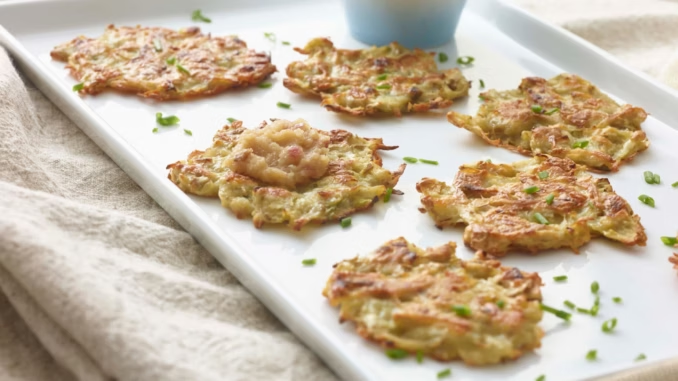
Oven-fried latkes use less oil and have a bit of extra flair with Paula Shoyer’s Potato and Scallion Latkes with Pickled Applesauce. The recipe is vegetarian and gluten-free. It serves six people and makes between 12-14 latkes.
Ingredients:
LATKES
2 tablespoons sunflower or safflower oil, or more if needed
½ medium onion, quartered
3 scallions, ends trimmed, cut into thin slices or chopped into small pieces
3 medium potatoes (about 1½ pounds [700g]), scrubbed clean and unpeeled
2 teaspoons (10ml) fresh lemon juice
2 large eggs
½ teaspoon baking powder
2 tablespoons potato starch
½ teaspoon salt
¼ teaspoon black pepper
PICKLED APPLESAUCE
1 teaspoon sunflower or safflower oil
1/3 cup red onions, chopped into ¼-inch (6-mm) pieces
2 tablespoons apple cider vinegar
2 tablespoons light brown sugar
2 apples, peeled and cut into ½-inch (12-mm) cubes
¼ teaspoon ground coriander
¼ teaspoon ground ginger
1 cinnamon stick
¼ teaspoon salt
Pinch black pepper
Instructions:
To make the latkes, preheat the oven to 450°F (230°C). When the oven is hot, pour 2 tablespoons of oil onto 2 jelly roll pans (1 tablespoon each) and turn them in every direction so that the oil coats the pans. Heat the pans in the oven for 5 minutes.
Place the onions and scallions in the bowl of a food processor and chop them into small pieces.
Place them in a medium bowl. Shred the potatoes by hand on the large holes of a box grater or in a food processor with the shredding blade and place in the bowl. Add the lemon juice, eggs, baking powder, potato starch, salt, and pepper and mix well.
Very carefully (I mean carefully: move very slowly) remove one of the pans and use your hands or a spoon to scoop up and drop clumps of the potato mixture, a little less than ¼ cup, onto the pan. I use my hands. Press the mixture down to flatten it a little.
Place the pan in the oven for 10 to 12 minutes and immediately remove the second oiled pan.
Repeat the same process with the remaining potato mixture and bake the second pan of latkes for 10 to 12 minutes. Bake them until the edges are well browned, and then with a slotted spatula turn them over and cook the latkes for another 8 to 10 minutes, or until the bottoms are browned. Yields 12-14 latkes.
May be made 2 days in advance and reheated in the oven.
Meanwhile, to make the applesauce, heat the oil in a small saucepan over medium heat. Add the onions and cook them for 3 minutes, until they soften. Add the vinegar and brown sugar and cook for another 3 minutes. Add the apples, coriander, ginger, cinnamon stick, salt, and pepper, and cook, covered, on low heat for 15 minutes, or until the apples are soft. Let the mixture cool for 10 minutes and then purée it, using an immersion blender or a food processor. May be made 4 days in advance and served warm or cold.
©Paula Shoyer Reprinted with permission from The Healthy Jewish Kitchen (Sterling Epicure 2017)
10. Add oil to challah and doughnuts.
In Paula Shoyer’s challah and doughnut dough recipe, she adds olive oil to the dough. Hanukkah oomph.

Olive oil challah and challah doughnut holes
Makes 2 medium challahs and 22 – 30 doughnut holes
Ingredients:
DOUGH
1/2 ounce (2 envelopes, 4 ½ teaspoons) dry yeast
1/3 cup warm water
3/4 cup plus 2 teaspoons sugar, divided
1/2 cup plus 1 teaspoon extra-virgin olive oil
1 tablespoon fine salt
1 cup boiling water
1/2 cup cold water
3 large eggs
6 – 6 ½ cups bread flour
oil for frying
TOPPINGS – EACH FOR HALF OF THE DOUGHNUTS
3 tablespoons Pereg Everything but the Bagel Spice, plus more to sprinkle on the braided loaves
1/4 cup sugar
¾ teaspoon ground cardamom
2 teaspoons cinnamon
Instructions:
In a 1-cup liquid measuring cup, dissolve the yeast in the 1/3 cup warm water. Add the teaspoon sugar and stir. Set aside for 10 minutes, or until thick.
In a large bowl, whisk together 1/2 cup of the olive oil, salt and 3/4 cup sugar. Add the boiling water and whisk to dissolve the salt and sugar. Add the cold water and whisk again. In a small bowl beat the eggs. Add the eggs to the oil mixture, reserving one tablespoon to brush the top of the braided loaves. When the yeast mixture thickens, add to the bowl and stir.
Add 6 cups of the flour, one cup at a time, mixing the flour in completely after each addition.
Place the dough on a floured surface and knead until smooth, adding a few tablespoons of flour at a time, until the dough is smooth. The dough is ready when you rub your palm across the dough, and it feels soft. You might not use up all the flour. Shape the dough into a ball.
Add the remaining teaspoon olive oil to the bowl and rub all around the bowl and on top of the dough. Place the dough into the oiled bowl and cover with plastic. Let rise for one hour.
Divide the dough into three balls, with two of them larger than the third. Set aside the smaller ball for the doughnuts. Braid the other two balls and place on a parchment-covered baking sheet.
Let rise for 45 minutes.
Take the remaining ball of dough and roll out on a floured surface until it is ½-inch thick. Cut into 1½-inch circles and place on a cookie sheet dusted generously with flour. You can reroll and cut the dough scraps or shape them into rolls. Cover doughnuts with a clean dishtowel and let rise for 45 minutes.
To bake the challahs, preheat the oven to 350ºF. Brush the tops of the challahs with beaten egg and sprinkle with the Everything but the Bagel Spice. Bake for 30 to 35 minutes, or until golden.
To make the doughnuts, heat 2 inches of oil in a medium saucepan and use a candy thermometer to see when the oil stays between 365ºF and 370ºF for a few minutes; adjust the flame so the oil stays in that temperature range.
Meanwhile, place the Everything but the Bagel Spice into a coffee grinder or a mortar and pestle and crush to break down the seeds and turn the mixture partially into a powder. Place into a shallow bowl.
Into another shallow bowl, place the sugar, cardamom and cinnamon and mix well.
You have enough toppings to roll half the doughnuts in the Everything Bagel Spice and half in the cinnamon cardamom sugar.
Cover a cookie sheet with foil. Place a wire rack on top and set near your stovetop. Carefully, add the doughnuts into the oil and cook for 1½ minutes. Cook no more than 6 or 7 at a time.
Use tongs or chopsticks to turn the doughnuts over and cook for another 1½ minutes, or until golden.
Use a slotted spoon to lift the doughnuts out, allowing the excess oil to drip off, shake a few times, and then drop into one of the shallow bowls and roll in the topping to coat all sides. Place the doughnuts on the rack. Repeat for the remaining doughnuts.
©Paula Shoyer Reprinted with permission from The Holiday Kosher Baker (Sterling 2013)




Be the first to comment